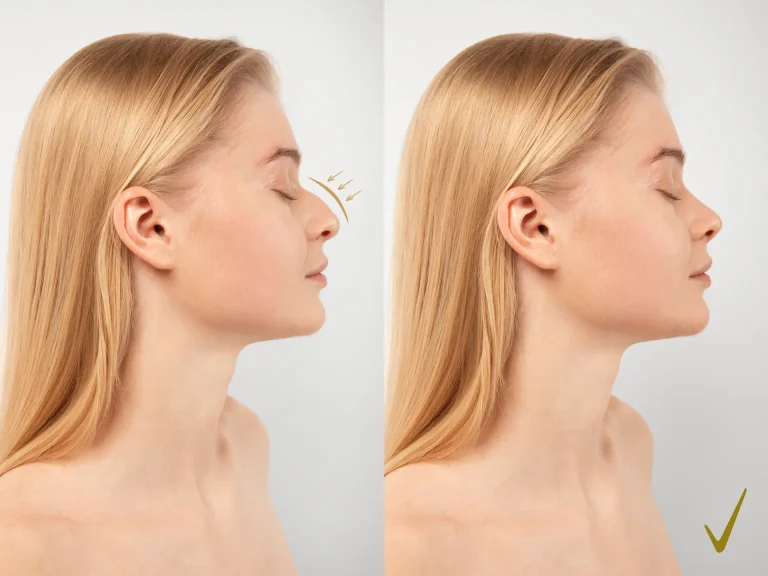

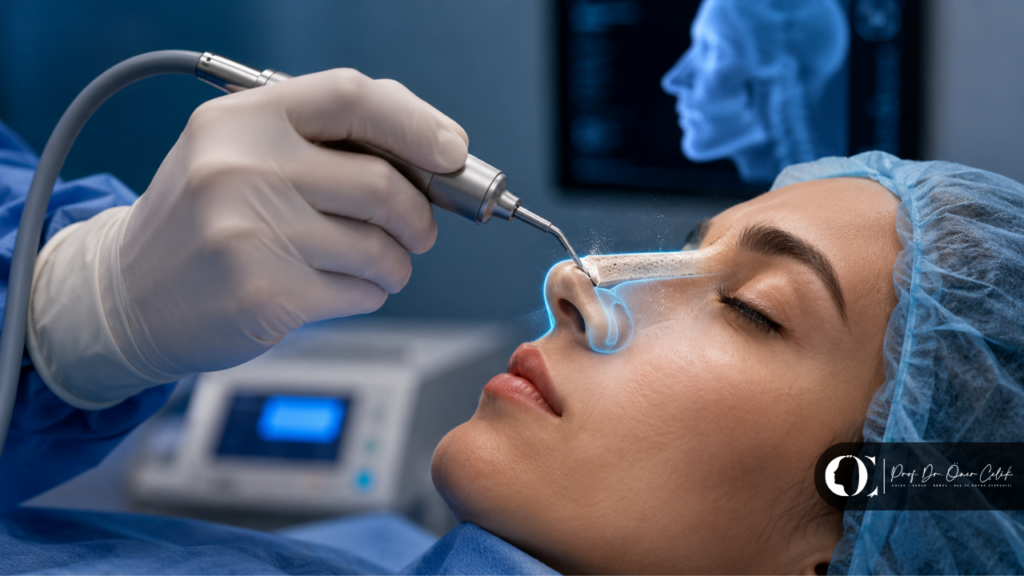
In piezo rhinoplasty the bone is still cut; what changes is the way it is cut. Instead of a hammer and chisel, a device working with ultrasonic vibrations cuts the bone in a controlled way and protects the surrounding soft tissue. This is why the phrase “rhinoplasty without breaking bone” is not technically accurate. The accurate description is controlled cutting instead of breaking.
Almost everyone researching rhinoplasty comes across one promise: “Rhinoplasty without breaking the nose.”
This phrase is naturally appealing to patients. Because the first image that comes to mind with rhinoplasty is bone being broken with a hammer, followed by weeks of bruising.
However, what the phrase actually means is often not explained. And when it is not explained, the patient forms a picture that will not happen in reality.
In this article I explain what the piezo method actually does, how accurate the word “without breaking” is, and what scientific studies say about this method.
Is “rhinoplasty without breaking bone” really possible?
Short answer: if the shape of the nasal bone is to be changed, intervention on the bone is unavoidable.
If a hump on the bridge is to be removed, the width of the nose narrowed or a deviated bone straightened, the bone must be cut. In medicine this is called an osteotomy, and it is also what is done with the piezo method.
So piezo does not eliminate the osteotomy. It changes how the osteotomy is performed.
| Conventional method | Piezo method | |
|---|---|---|
| Instrument used | Chisel and hammer, rasp | Ultrasonically vibrating tip |
| Effect on bone | Controlled fracture | Controlled cutting |
| Effect on soft tissue | May be affected | Selective; does not cut soft tissue |
| Field of view | May be limited | Clearer |
| Precision | Millimetre control is harder | Millimetre control is easier |
The key feature of the piezo device is that it works selectively. Ultrasonic vibration within a certain frequency range cuts hard tissue — that is, bone — while not cutting soft tissues such as blood vessels, nerves and mucosa.
This removes the point that causes the most problems with the conventional method: damage to the surrounding soft tissue as the chisel advances, and the resulting swelling and bruising.
So the word “without breaking” in marketing language actually means “without breaking with a hammer, by cutting in a controlled way”. The bone is still divided.
So is there any method in which the bone is not touched at all?
Yes, but these are different procedures used for different problems.
In procedures aimed only at the nasal tip, or in temporary corrections with fillers, the bone is not touched. However, these methods do not meet needs such as removing a hump, narrowing the bridge or straightening a bony deviation.
In short: not touching the bone is possible if there is no bone-related problem. If there is a hump or a bony deviation, it is not possible — whatever device is used.
The evidence-supported advantages of the piezo method
This section brings good news: despite the marketing language discussed above, the benefits of the piezo method are supported by science.
A systematic review and meta-analysis published in August 2026, which assessed randomised controlled trials using the GRADE method, reported the following findings:
Mucosal protection — the strongest finding
This is the most striking of all the findings: no loss of mucosal integrity was seen in any of the piezo cases. A significant difference compared with the conventional method was reported (RR 0.09).
The mucosa is the thin membrane lining the inside of the nose and plays a decisive role in healing. Preserving it affects both comfort during recovery and long-term function.
Swelling and bruising
In the meta-analysis, swelling was significantly lower in favour of piezo on postoperative days 2 and 7. However — and this detail matters — no significant difference was found on days 1, 3 and 4.
The difference is more consistent for bruising: a significant reduction in favour of piezo was reported on days 1, 2 and 7.
In another review covering eight randomised trials and 440 patients, a significant difference in favour of piezo was found in 75% of studies for early swelling and in 87.5% for bruising.
The practical meaning is this: piezo does not eliminate bruising and swelling. It reduces them and helps them resolve sooner. The claim “there is no bruising at all” goes beyond the current evidence.
Pain
On postoperative day 2, pain scores were significantly lower in the piezo group, and a reduction in the need for painkillers was also reported.
Operating time
There is a common misconception here: “piezo makes the operation longer.”
In a meta-analysis covering twelve randomised trials, no significant difference in operating time was found between the two techniques. The 2026 review also stated that osteotomy time did not differ significantly, although variability between studies was high.
So time is not a decisive disadvantage of this method.
The limits of the evidence
This section is necessary for an honest assessment.
All the findings above relate to early outcomes — the first week, at most the first months. The meta-analyses explicitly state that there are insufficient data on long-term outcomes.
So the answers to these questions are not yet clear: is the aesthetic result five years after a piezo operation different from the conventional method? Are revision rates different? There are not yet enough long-term studies to answer these questions definitively.
In short: the advantage of piezo during recovery is supported. Superiority in the final aesthetic result has not been proven.
This distinction matters, because what really determines the result is not the device but the planning and surgical technique. A device can make a good plan easier to carry out; it does not fix a bad plan.
When does piezo make more of a difference?
The situations where the advantage is most noticeable are:
- Noses that need a prominent hump removed. Cases requiring extensive work on the bone.
- Thin bony structure. In thin bone, control with the conventional method is more difficult.
- Patients with thin skin. Every irregularity on the bone becomes visible from the outside; millimetre control is decisive here.
- Revision operations. In noses that have been operated on before and whose anatomy has changed, a clear view becomes important.
- Asymmetric bony structure. Cases that require different degrees of intervention on each side.
By contrast, in cases where the problem lies entirely in the nasal tip and the bone will not be touched at all, piezo offers no additional advantage — because the device is an instrument that works on bone.
I covered the general course of the operation and how each technique is applied in detail in the article on open rhinoplasty.
The breathing side should not be forgotten
Piezo is a method concerned with shaping the bone. Problems that make breathing difficult, however, arise from different structures: deviation of the internal partition, enlarged turbinates, narrowing at the level of the nasal valve.
That is why a breathing assessment should also be done when aesthetic planning is carried out. Breathing should not get worse while appearance improves; in fact, in most cases both are improved together.
I explained how a deviation inside the nose is assessed in the article on how to tell if your septum is deviated, and turbinate enlargement in the article on turbinate hypertrophy. For procedures aimed only at the internal partition, see the septoplasty page.
The device or the surgeon?
This question needs a clear answer, because there is a promotional language in the market built around the device.
Piezo is an instrument in the surgeon’s hands. A good instrument, used correctly, makes the work easier and reduces certain risks. But it is not the device that decides how the nose will look, how much of the hump will be removed or how the tip will be positioned.
The piezo device is also equipment that requires investment and may not be available at every centre. However, just as the presence of the device is not on its own an indicator of quality, its absence does not mean a poor result.
The question to ask is not “do you use piezo” but rather: which procedures will be performed on my nose, is work on the bone needed, is there a problem on the breathing side, and what can I expect as a result?
In summary
The piezo method is based on shaping the nasal bone by cutting it with ultrasonic vibrations. Thanks to its selective working principle, which protects soft tissue, it significantly reduces mucosal damage; randomised trials support that it reduces swelling, bruising and pain in the early period.
However, the phrase “rhinoplasty without breaking bone” is not technically accurate. If there is a hump or a bony deviation, intervention on the bone is unavoidable; piezo does this by cutting, not by breaking.
In addition, the method’s advantage has been shown during recovery; its superiority in the final aesthetic result has not yet been proven. What really determines the result is not the device used but correct planning and surgical technique.
For anyone considering rhinoplasty, it is advisable to be assessed by an ear, nose and throat specialist to determine which procedures are needed and whether there is a problem on the breathing side.
You can send any questions you have via WhatsApp; I add frequently asked topics to the article.
This content is for information only and does not replace a medical examination, diagnosis or treatment. Results vary from person to person. For your individual situation, please consult a physician in the relevant specialty.
Frequently Asked Questions
Is rhinoplasty without breaking bone really possible?
If the shape of the nasal bone is to be changed, intervention on the bone is unavoidable. The piezo method cuts the bone in a controlled way with ultrasonic vibration instead of breaking it with a hammer. So “without breaking” does not mean that the bone is not touched at all.
Is there no bruising at all with the piezo method?
No. Meta-analyses report that the piezo method significantly reduces bruising on postoperative days 1, 2 and 7. However, bruising does not disappear completely; it is reduced and resolves sooner.
Does piezo make the operation longer?
In a meta-analysis covering twelve randomised trials, no significant difference in operating time was found between the two techniques. Time is not a decisive disadvantage of this method.
Does the piezo method give a better aesthetic result?
The proven advantage relates to the recovery period: mucosal protection and reduced swelling, bruising and pain. There are not enough long-term data to show superiority in the final aesthetic result. What really determines the result is planning and surgical technique.
In which patients does piezo make more of a difference?
The advantage is more noticeable in patients who need a prominent hump removed, who have thin bones or thin skin, who are undergoing revision surgery or who have an asymmetric bony structure. It offers no additional benefit when the problem is only in the nasal tip.
Does piezo also correct breathing problems?
Piezo is a method concerned with shaping the bone. Septal deviation, enlarged turbinates and valve narrowing, which make breathing difficult, arise from separate structures and should be assessed separately. In most cases aesthetic and functional correction can be done in the same session.
Does the absence of a piezo device mean a poorer result?
The presence of the device is not on its own an indicator of quality, and its absence does not mean a poor result. Piezo is an instrument in the surgeon’s hands. What is decisive is correct planning, anatomical assessment and surgical technique.
Why is mucosal protection important?
The mucosa is the thin membrane lining the inside of the nose and plays a decisive role in healing. In the meta-analysis, no loss of mucosal integrity was seen in any of the piezo cases, and a significant difference compared with the conventional method was reported.
Prof. Dr. Öner Çelik — Otorhinolaryngology, Head and Neck Surgery. A graduate of Istanbul University Faculty of Medicine, he completed his ENT specialty training at Taksim Training and Research Hospital. He served as a faculty member in the Department of Otorhinolaryngology and Head and Neck Surgery at Maltepe University Faculty of Medicine and, in 2013, completed advanced training in endoscopic sinus surgery and skull base surgery at The Ohio State University Wexner Medical Center. About me
Sources
- Armanfar S, Rasti Ardakani M, Vahidiataabadi M. Piezoelectric Versus Conventional Rhinoplasty: A GRADE-Assessed Systematic Review and Meta-analysis of Randomized Controlled Trials. Aesthetic Surgery Journal 2026;46(8):891-906.
- Is Piezosurgery Associated with Improved Patient Outcomes Compared to Conventional Osteotomy in Rhinoplasty? A Systematic Review and Meta-Analysis of RCTs. Journal of Clinical Medicine 2024;13:3635 (12 RCTs, 630 patients).
- A Comparison Between Piezosurgery and Conventional Osteotomies in Rhinoplasty on Post-Operative Oedema and Ecchymosis: A Systematic Review (8 RCTs, 440 patients).
- Effect of piezoelectric osteotomy on postoperative oedema and ecchymosis after rhinoplasty: systematic review and meta-analysis (6 studies, 327 patients).
This content is for information only and does not replace medical advice. Every medical procedure requires an individual assessment and may carry risks. Results vary from person to person.