
What is rhinoplasty?
Rhinoplasty is an operation that reshapes the bone and cartilage of the nose so that it is in harmony with the face. “Rhinoplasty” is the medical name; “nose reshaping” and “nose job” are everyday names for the same operation.
A good nose is not only one that looks right from the outside; it is a nose that breathes comfortably, smells and humidifies the air. That is why the inside of the nose is assessed as carefully as its appearance when the operation is planned. If there is a deviated septum, enlarged turbinates or chronic sinusitis, these can be corrected in the same operation; this combined operation is called septorhinoplasty.
Who is it suitable for?
Rhinoplasty can be considered for people whose nose has finished growing and who are bothered by its size, a hump, a deviation, the shape of the tip or its balance with the face. Growth of the nose is usually complete at around 16–17 in women and 18 in men.
- A change in shape: a hump on the bridge, a wide or drooping tip, a crooked appearance.
- A breathing problem as well: if a deviated septum, enlarged turbinates or a narrow nasal valve is present, function and appearance are addressed in the same operation.
- A nose bent after an injury: noses whose shape and breathing have both changed after an accident or a sports injury.
- Previous surgery: revision rhinoplasty is planned separately for people who did not get the expected result from a first operation.
General health that is suitable for surgery and anaesthesia, being able to follow the aftercare instructions and realistic expectations matter as much as age. The aim is a nose that looks natural and suits the face.
How are the consultation and planning done?
Planning starts with a full ear, nose and throat examination. The inside of the nose is examined with an endoscope; the septum, turbinates, sinus openings and the back of the nose are assessed. If chronic sinusitis is suspected, a sinus CT scan is requested and, if needed, sinus surgery is added to the same session.
A facial analysis follows: the thickness of the nasal skin and the proportions between the nose and the forehead, cheekbones, chin and lips are assessed, and standard photographs are taken. A computer simulation on the photographs may be used. A simulation is a communication tool that helps the surgeon and the patient talk about the same nose; it does not show the result of the operation.
At the end of the consultation, the technique that suits you, the extent of the operation, the possible risks and the recovery timeline are explained clearly.
Which techniques are used?
The technique is chosen according to the structure of the nose and the size of the change; there is no single right technique for every nose.
- Closed rhinoplasty: all incisions are inside the nostrils, so there is no external scar. Swelling and bruising are usually less and feeling at the tip returns sooner. It may not be suitable for major changes in shape or for revisions.
- Open rhinoplasty: a small incision is made on the column between the nostrils (columella). It is preferred for marked deviations and fractures, when symmetry is needed at the tip, and in revisions. The scar usually becomes barely visible over time.
- Piezo (ultrasonic) instruments: not a technique but a device that shapes the nasal bones with ultrasonic vibration. Instead of breaking the bone, it cuts only the part that needs to change, with less effect on the surrounding tissue; it can be used in both open and closed operations.
The aim of the operation also shapes the plan: the bridge or the tip can be reduced, a collapsed bridge can be supported and raised with cartilage, or only the tip can be corrected (tip rhinoplasty). In most first-time operations the patient’s own septal cartilage is enough; ear or rib cartilage is needed more often in revisions.


How is the operation performed?
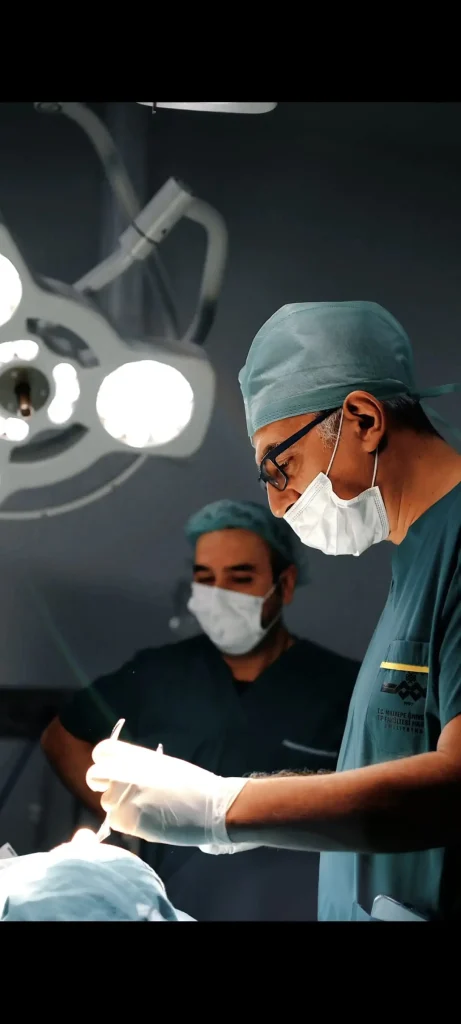
Rhinoplasty is performed under general anaesthesia and takes 2–3 hours on average. Operations take place at Maltepe University Hospital in Istanbul.
- Preparation: after the anaesthetist’s assessment you are put to sleep, and a local medicine that reduces bleeding is applied to the nose.
- Access: incisions are made according to the chosen technique and the bone and cartilage under the skin are reached.
- Shaping: a hump is rasped or shaped with the piezo device, the septum is straightened and the tip cartilages are reshaped with stitches. If needed, cartilage taken from the septum is used for support.
- Finishing: the incisions are closed, silicone packs are placed inside the nose and a protective splint on the bridge.
Waking up and recovery from anaesthesia take about 30–40 minutes. You stay one night in hospital and are discharged the next morning after a check.
What should you do before the operation?
- Stopping smoking and alcohol a few weeks before the operation supports healing and lowers the risk of bleeding and infection.
- Aspirin and other blood thinners, some painkillers, vitamin E and some herbal supplements can increase bleeding. When to stop a medicine is decided with the doctor who prescribed it; do not stop your medicines on your own.
- Blood tests and other necessary tests are done before the operation, and the anaesthetist assesses you.
- The fasting time and the time to arrive at the hospital are given to you separately by the anaesthesia team. On the morning of the operation there should be no face cream or make-up and no nail varnish; contact lenses and jewellery should be removed.
Recovery: what to expect day by day
Most people return to work or school within 7–10 days after rhinoplasty; the nose takes about a year to reach its final shape.
| Period | What to expect |
|---|---|
| First 24 hours | A blocked nose, mild pain and swelling around the eyes. Pain is controlled with the prescribed medicines; ice is applied over the eyes at intervals. |
| Days 2–3 | Swelling and bruising are at their most visible. Sleep on your back with your head raised; continue the ice at home. |
| Days 4–5 | Swelling and bruising ease noticeably. Avoid heavy lifting, bending forward and strenuous work. |
| Days 6–7 | First check-up: the packs inside the nose and the splint on the bridge are removed and taping is applied; nasal rinsing and care are explained. |
| Days 7–10 | Most people return to work or school. |
| Weeks 2–4 | Sauna, hot baths, strenuous exercise and glasses resting on the bridge are still not advised. |
| Month 1 | Most of the swelling settles and breathing feels clearly easier. A gradual return to sport begins. |
| Months 3–6 | The remaining swelling, especially at the tip, slowly resolves; the shape becomes clearer. |
| Month 12 | The nose has largely reached its final shape. |
For patients travelling from abroad, a stay in Istanbul until the first check-up, when the packs and splint are removed (day 6–7), is advised. Your personal timeline for glasses, sport and flying is set at the check-ups.
What are the risks?
Like any operation, rhinoplasty carries risks; they are discussed in detail before the operation.
- Bleeding, infection and risks related to anaesthesia
- Prolonged swelling, especially in thick-skinned noses
- Temporary numbness at or around the tip
- Slight asymmetry or not fully reaching the intended shape
- Breathing complaints that persist
The medical literature reports that a corrective (revision) operation may be needed in 5–10 per cent of first-time rhinoplasties. If a correction is needed, at least a year is usually allowed for the tissues to heal.
If you develop increasing pain, fever, redness, discharge, abnormal bleeding or new difficulty breathing after the operation, contact your surgeon without delay.
How does the process work with Prof. Dr. Öner Çelik?
Prof. Dr. Öner Çelik is an ear, nose and throat and head and neck surgeon; he approaches rhinoplasty together with breathing, the sinuses and the structures inside the nose.
- Consultation: endoscopic examination of the nose, facial analysis and photographs at the clinic in Suadiye, Istanbul.
- Planning: a CT scan is requested if needed; the technique, extent, risks and recovery timeline are discussed together.
- Operation: at Maltepe University Hospital, with one night in hospital.
- Check-ups: the first check-up is about a week later; further check-ups take place at the clinic as healing progresses.
The consultation and treatment steps, including planning for patients travelling from abroad, are explained on the your treatment in Istanbul page. The fee depends on the technique and the extent of the operation and is given to you personally after the consultation.
Who is it not suitable for?
- People whose nose has not finished growing
- People with a bleeding or clotting disorder, or whose general health is not suitable for anaesthesia
- People with a condition such as body dysmorphic disorder that would make it hard to be satisfied with surgery
- People who cannot follow the aftercare instructions
Frequently asked
From what age can rhinoplasty be done?
Rhinoplasty requires the nose to have finished growing; this is usually after about 16–17 in women and 18 in men. Alongside age, general health and realistic expectations of the operation are also assessed.
More detail: Rhinoplasty in Istanbul.
How long does rhinoplasty take, and do I need to stay in hospital?
The operation takes 2–3 hours on average under general anaesthesia, with one night in hospital. Silicone packs are placed inside the nose and a splint outside; both are removed at the check-up 6–7 days later.
More detail: Rhinoplasty in Istanbul.
When can I return to work or school after rhinoplasty?
Most people can return to work or school after 7–10 days. Swelling and bruising peak on days 2–3 and have largely eased by the end of the first week; heavy lifting, bending forward and strenuous work are not advised during this period.
More detail: Rhinoplasty in Istanbul.
When are glasses, sport and flying possible after rhinoplasty?
Glasses should not rest directly on the bridge of the nose for 4–6 weeks. The return to sport is gradual: apart from light walking, exercise is not advised for the first two weeks; full training usually resumes from week 6 and contact sports after 6–8 weeks. Sources advise waiting between 7 days and 2 weeks before flying, and unnecessary flights are avoided in the first month. Your personal timeline is set by the surgeon who performs the operation.
More detail: Rhinoplasty in Istanbul.
How long until the nose reaches its final shape, and is the result permanent?
Most of the swelling settles within the first month, but the nose takes about a year to reach its final shape; its appearance in the first months does not show the final result. The changes made are permanent; the natural changes of the face with age can also affect the nose to some degree.
More detail: Rhinoplasty in Istanbul.
What is the difference between open and closed rhinoplasty?
In the closed technique all incisions are inside the nose, there is no external scar and swelling is usually less; however, it is not always suitable for major changes in shape or for revisions. In the open technique a small incision is made on the column between the nostrils (columella); it is preferred for marked deviations and fractures and in revision operations. The technique is chosen at the consultation according to the structure of the nose.
More detail: Rhinoplasty in Istanbul.
How long after the first operation can revision rhinoplasty be done?
Ideally, at least a year is allowed after the first operation for the nose to settle fully; rarely, an intervention may be needed at the earliest after 6 months, and this decision is made by the surgeon. Because the tissues have been operated on before, planning is more detailed, and if cartilage is needed it may be taken from the ear or a rib.
More detail: Revision rhinoplasty.
How should I sleep after rhinoplasty?
For the first weeks, sleeping on your back with your head raised on a few pillows is advised; this helps the swelling around the eyes go down sooner. Sleeping face down, which would press on the nose, is avoided. When you can sleep on your side is decided at the check-up according to how the nose is healing.
Articles on this topic
- Closed Rhinoplasty: What to Know About Surgery Without an External Incision Closed rhinoplasty is a technique in which all incisions are made inside the nostrils, so no external scar…
- Revision Rhinoplasty Revision rhinoplasty is an operation to correct a shape problem or breathing problem remaining after a previous rhinoplasty.…
- What Is Open Rhinoplasty? Open rhinoplasty is a technique in which the cartilage and bone framework is shaped under direct vision through…
- What Is Septorhinoplasty? Septorhinoplasty corrects a deviated septum inside the nose and the outer shape of the nose in the same…
- Who Should Not Have Rhinoplasty? Rhinoplasty is not recommended for young people whose nasal growth is not complete, for uncontrolled heart, lung or…
- Rhinoplasty for Thick-Skinned Noses: Impossible or Just Harder? Rhinoplasty is possible on thick-skinned noses; however, the goal is not very thin, sharp contours but a natural…
References
- Ishii LE et al. Clinical Practice Guideline: Improving Nasal Form and Function after Rhinoplasty. Otolaryngol Head Neck Surg. 2017;156(2_suppl):S1-S30.
- Han JK et al. Clinical Consensus Statement: Septoplasty with or without Inferior Turbinate Reduction. Otolaryngol Head Neck Surg. 2015;153(5):708-720.
This content is for information only and does not replace medical advice. Every medical procedure requires an individual assessment and may carry risks. Results vary from person to person.