
The most common causes of a swelling noticed inside the nose are enlarged turbinates and nasal polyps; both are benign. A painful, red swelling just inside the nostril is usually an infected hair follicle. Swellings that are on one side only, cause blood-stained discharge or one-sided blockage and do not go away should be examined with an endoscope and, if necessary, biopsied.
“There is a swelling inside my nose” can describe very different conditions. Most of them, ranging from a red swelling visible in the mirror to a mass that can only be seen with an endoscope, are harmless. But a few distinguishing signs show which ones can wait and which ones need to be looked at promptly.
Common causes of swelling inside the nose
| Cause | How does it look / feel? | Usually |
|---|---|---|
| Enlarged turbinates (turbinate hypertrophy) | Pink, soft bulge on the side wall of the nose; blockage changes during the day and with the side you lie on | Both sides; associated with allergy and chronic rhinitis |
| Nasal polyp | Pale, grey-yellow, grape-like, painless soft tissue; loss of smell is common | Mostly both sides; together with chronic sinusitis |
| Nostril infection (vestibulitis, furuncle) | Red, painful swelling just inside the nostril, tender to the touch | Develops quickly; infection of a hair follicle |
| Deviated septum | A bulge towards one side inside the nose; firm in consistency | Not a swelling but a deviation of the partition |
| Nasal and sinus tumours | One-sided, growing mass; blood-stained discharge, one-sided blockage | Rare; distinguished by biopsy |
Enlarged turbinates
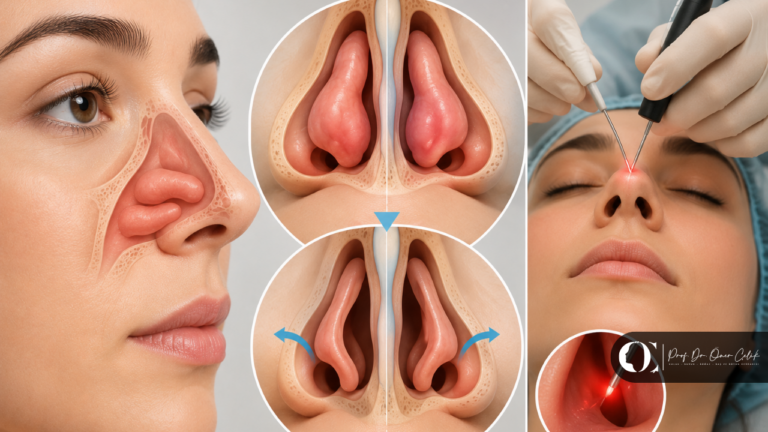
The turbinates are structures on the side wall of the nose that warm and humidify the air we breathe. They can enlarge because of allergy, frequent colds or long-term use of nasal sprays. The blockage is usually on both sides and may switch sides during the day.
Treatment starts with medication; if there is no response, the turbinates can be reduced with radiofrequency or surgery. Details are in the article on enlarged turbinates and on the turbinate surgery page.
Nasal polyps
Nasal polyps are benign, soft swellings that develop from the lining of the nose and sinuses on the background of chronic sinusitis. They are usually on both sides and show themselves with the following symptoms:
- Persistent nasal blockage
- Reduced sense of smell and taste
- Postnasal drip
- Facial fullness or pressure
The European Position Paper on Rhinosinusitis and Nasal Polyps recommends starting treatment of chronic sinusitis with polyps with intranasal steroid sprays and nasal rinsing. In patients who do not respond to medication, endoscopic sinus surgery is considered; I covered this in the article when is sinus surgery needed.
Why does a one-sided swelling deserve special attention?
A polyp or mass on one side only is assessed differently from polyps on both sides. In a study of 77 patients operated on for a one-sided, benign-appearing nasal polyp:
- In 77.9% of patients, the polyp turned out to be an ordinary inflammatory polyp.
- In 14.3%, a benign tumour was found; most of these were inverted papillomas.
- In 2.6%, a malignant tumour was found.
- The remaining 5.2% had other, non-tumour findings.
For this reason, the researchers recommend that all one-sided polyps be sent for pathological examination.
What is an inverted papilloma?
Inverted papilloma is the most common benign tumour of the nose and sinuses. Although it is benign, three features set it apart from other polyps: it can destroy surrounding tissue locally, it has a high tendency to recur and it carries a risk of becoming cancerous. In a meta-analysis of 3,177 patients, the rate of malignant transformation in this group of tumours was about 9%. For this reason, complete removal once diagnosed and regular endoscopic follow-up after surgery are recommended.
A painful swelling in the nostril
A red, painful swelling that develops quickly just inside the nostril is usually an infected hair follicle (furuncle). Nose picking, pulling out hairs and frequent nose blowing make it more likely.
Inflamed swellings inside the nose should not be squeezed. The veins in this area are connected to the deep veins of the face; squeezing can cause the infection to spread. If there is fever or the swelling spreads to the cheek or around the eye, medical attention should be sought without delay.
Which symptoms should be assessed without delay?
- Blockage on one side only that has not gone away for several weeks
- One-sided, recurrent blood-stained discharge or nosebleeds
- Numbness, pain or swelling in the face
- Watering of the eye, double vision or the eyeball being pushed forward
- Swelling of the palate or loosening of teeth
Most of these symptoms have benign causes; however, assessment should not be postponed when complaints are one-sided and persistent.
How is a swelling inside the nose assessed?
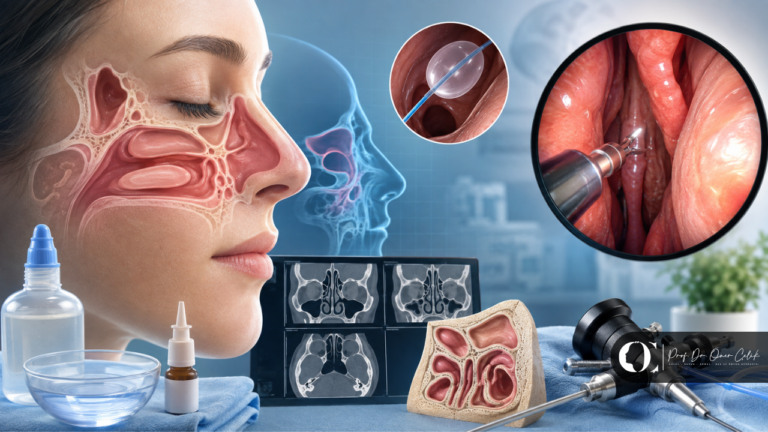
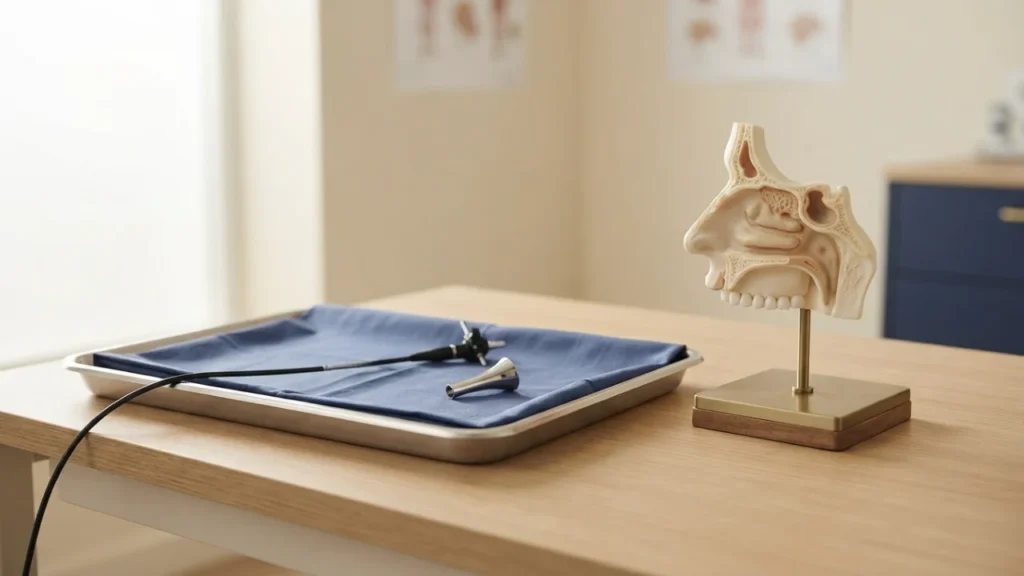
The inside of the nose is examined with a thin endoscope; the location, colour and consistency of the swelling, and whether it is on one or both sides, are assessed. If necessary, a CT or MRI scan is requested. A biopsy is taken from masses that look suspicious or are on one side only.
The diagnosis, treatment and follow-up of nasal and sinus tumours are described on the sinonasal tumour surgery page.
References
- Edafe O et al. The incidence of significant pathology in patients presenting with benign-appearing unilateral nasal polyps. J Laryngol Otol, 2022. pubmed.ncbi.nlm.nih.gov
- Re M et al. Malignant transformation of sinonasal inverted papilloma and related genetic alterations: a systematic review. Eur Arch Otorhinolaryngol, 2017. pubmed.ncbi.nlm.nih.gov
- Lisan Q et al. Sinonasal inverted papilloma: From diagnosis to treatment. Eur Ann Otorhinolaryngol Head Neck Dis, 2016. pubmed.ncbi.nlm.nih.gov
- Fokkens WJ et al. European Position Paper on Rhinosinusitis and Nasal Polyps 2020. Rhinology, 2020. pubmed.ncbi.nlm.nih.gov
This content is for information only and does not replace medical advice. Every medical procedure requires an individual assessment and may carry risks. Results vary from person to person.