
Laser snoring treatment means reducing the soft palate and uvula with a laser; it can be an option for simple snoring, but it is not recommended for treating sleep apnoea. Whether a method will work is determined not by the type of device but by where the airway narrows. That is why snoring treatment starts by establishing whether sleep apnoea is present and where the narrowing is.
“Laser snoring treatment” is one of the most searched-for methods. The idea of a solution completed in a single, short session is appealing. But snoring does not have a single cause, and the same method does not give the same result in everyone. In this article I explain when laser, radiofrequency and surgery make sense.
First question: simple snoring or sleep apnoea?
This is the first step in choosing a treatment. In simple snoring, breathing does not stop during sleep; the problem is mostly the sound itself. In obstructive sleep apnoea, however, the airway closes again and again during sleep and breathing stops for short periods.
Sleep apnoea cannot be diagnosed by questionnaire or clinical assessment alone; the American Academy of Sleep Medicine guideline recommends a sleep study for diagnosis (polysomnography or, in suitable patients, a home sleep test). The following signs suggest sleep apnoea:
- Your bed partner noticing that your breathing stops during sleep
- Waking up with a choking sensation
- Waking up tired despite sleeping a long time, daytime sleepiness
- Morning headache, difficulty with attention and concentration
If sleep apnoea is overlooked and a procedure targets only the snoring sound, the sound may decrease but the underlying problem continues. That is why it is recommended that sleep apnoea is ruled out first in anyone being considered for snoring surgery.
What is laser snoring treatment?
Laser-assisted uvulopalatoplasty (LAUP) is the cutting and reduction of excess tissue in the soft palate and uvula with a laser. It can be performed under local anaesthesia as an outpatient procedure.
The American Academy of Sleep Medicine practice parameters reached two clear conclusions about this method:
- It is not recommended for the treatment of sleep-related breathing disorders, including sleep apnoea.
- In simple snoring it may give results similar to conventional soft palate surgery. In these patients, sleep-related breathing disorders should be investigated before the procedure and regular evaluation should follow.
In a systematic review of the side effects of soft palate surgery, persistent complaints such as difficulty swallowing, a foreign-body sensation in the throat or voice changes were reported in about half of patients after operations in which palatal tissue was removed. For this reason, patient selection is particularly important for procedures that permanently reduce palatal tissue.
What is radiofrequency treatment?
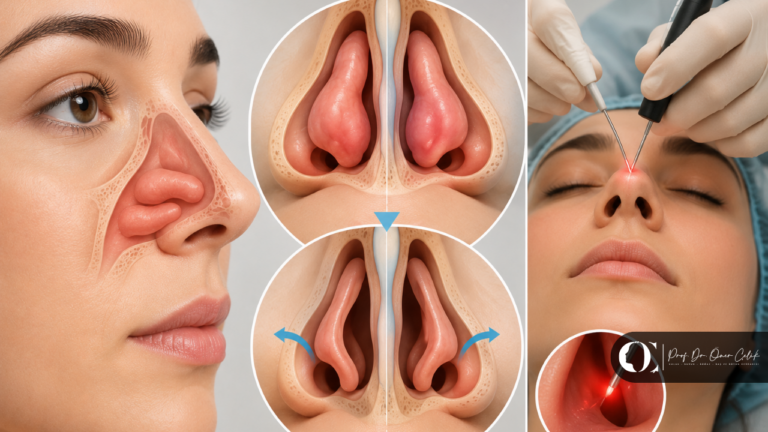
Radiofrequency is a method in which a thin probe placed inside the soft palate shrinks and stiffens the tissue using low heat. No tissue is removed from the surface of the palate.
A systematic review on this subject reached the following conclusions:
- In the only randomised trial comparing it with placebo, radiofrequency was found to be more effective.
- Postoperative pain is lower than with other methods; no serious side effects were reported.
- It can reduce snoring at least in the short term; however, most studies had short follow-up, and it is difficult to say anything definite about the long-term effect.
The same technique is also used for enlarged turbinates; I explained this in the article on enlarged turbinates and radiofrequency.
Which method suits whom?
| Site of narrowing / situation | Approach that may be considered |
|---|---|
| Nasal blockage (deviation, enlarged turbinates, valve narrowing) | Nasal surgery; on its own it does not treat apnoea, but it can reduce snoring and make device use easier |
| Long uvula, sagging soft palate, simple snoring | Radiofrequency or soft palate surgery |
| Large tonsils | Tonsillectomy |
| Narrowing at the base of the tongue | Tongue base procedures; in selected patients |
| Moderate or severe sleep apnoea | Primarily a positive airway pressure device (CPAP); surgery in selected patients |
| Apnoea patient unable to use the device, or simple snoring | An oral appliance that holds the lower jaw forward |
In most patients the narrowing is at more than one level. A procedure on the palate alone does not resolve snoring that originates from the nose or the base of the tongue.
What can be done without surgery?
For many patients, the first step is non-surgical:
- Losing weight and exercising regularly
- Avoiding alcohol and sedatives before bed
- Sleeping on your side rather than on your back
- Treating allergies or nasal blockage
- Oral appliance: the American Academy of Sleep Medicine recommends that patients with simple snoring who want treatment use these appliances rather than remain untreated.
What is evaluated in the assessment?
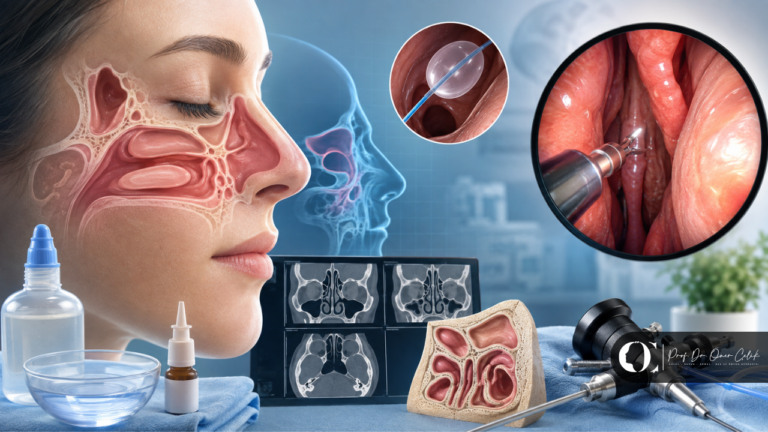
The inside of the nose is examined with an endoscope; the soft palate, uvula, tonsils, tongue base and larynx are evaluated. Weight, neck circumference and jaw structure are also taken into account. If sleep apnoea is suspected, a sleep study is requested.
When this information is brought together, the question “laser, radiofrequency or surgery?” can be answered on an individual basis. All treatment options, the recovery process and the risks are described on the snoring surgery page.
References
- Littner M et al. Practice parameters for the use of laser-assisted uvulopalatoplasty: an update for 2000. Sleep, 2001. pubmed.ncbi.nlm.nih.gov
- Bäck LJ et al. Radiofrequency ablation treatment of soft palate for patients with snoring: a systematic review of effectiveness and adverse effects. Laryngoscope, 2009. pubmed.ncbi.nlm.nih.gov
- Franklin KA et al. Effects and side-effects of surgery for snoring and obstructive sleep apnea – a systematic review. Sleep, 2009. pubmed.ncbi.nlm.nih.gov
- Kapur VK et al. Clinical Practice Guideline for Diagnostic Testing for Adult Obstructive Sleep Apnea. J Clin Sleep Med, 2017. pubmed.ncbi.nlm.nih.gov
- Ramar K et al. Clinical Practice Guideline for the Treatment of Obstructive Sleep Apnea and Snoring with Oral Appliance Therapy: An Update for 2015. J Clin Sleep Med, 2015. pubmed.ncbi.nlm.nih.gov
This content is for information only and does not replace medical advice. Every medical procedure requires an individual assessment and may carry risks. Results vary from person to person.