
Eardrum perforations caused by a blow or a pressure change often close on their own; perforations caused by chronic ear infection usually do not. If the perforation has not closed within about three months, or if it causes hearing loss and recurrent ear discharge, surgical repair of the eardrum (tympanoplasty) is considered.
When the eardrum is perforated, the first question is usually the same: “Will I need surgery?” The answer depends on the cause, location and size of the perforation. In this article I explain which perforations can be watched and which ones need repair.
Why does the eardrum perforate?
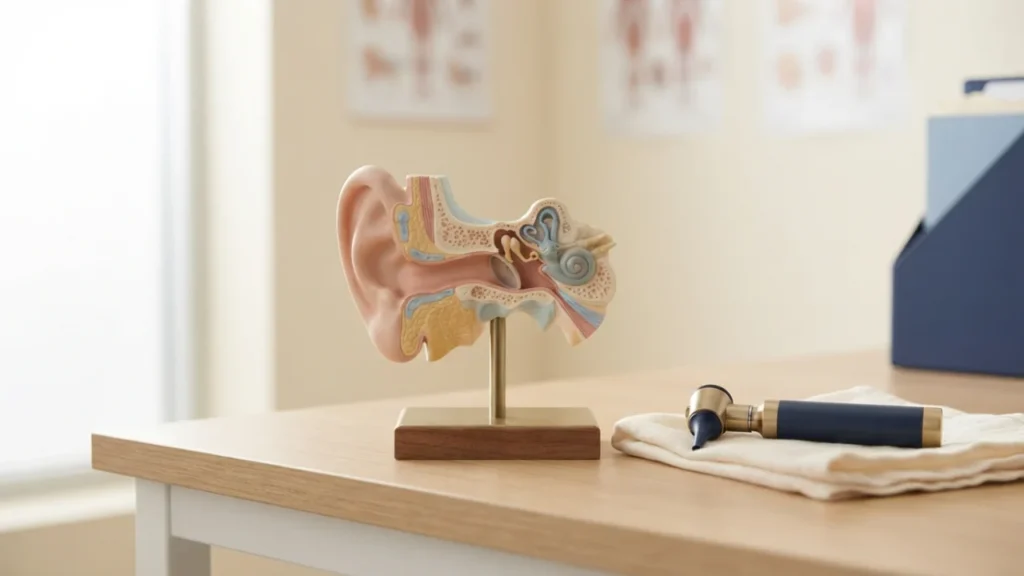
The eardrum is a thin membrane that separates the outer ear canal from the middle ear. There are two main causes of perforation:
| Traumatic perforation | Infection-related perforation | |
|---|---|---|
| Cause | A slap, a blow, a blast, a cotton bud, diving or a pressure change during a flight | Recurrent or long-standing middle ear infection |
| Onset | Sudden; the event is remembered | Insidious; episodes of discharge over the years |
| Spontaneous closure | Common | Rare |
| First approach | Watchful waiting while keeping the ear dry | Drying up the infection, followed by a repair plan |
Does it close on its own, and how long does it take?
Perforations caused by trauma usually close on their own within a few weeks to a few months. In a study in which 40 patients with a traumatic eardrum perforation were followed for a long period, 67.5% of the perforations closed spontaneously:
- 6 patients: in less than 2 weeks
- 9 patients: within 4 weeks
- 5 patients: within 3 months
- 7 patients: between 3 months and more than 6 months
The same study found that perforations touching the small bone attached to the centre of the eardrum (the malleus) closed less often. Perforations that showed signs of closing at six months were reported to be able to close during longer follow-up as well.
What to watch out for while waiting
- Keep the ear dry: place a cotton ball coated with petroleum jelly in the ear when showering, and take a break from swimming.
- Do not put drops or oil in the ear unless a doctor recommends it.
- Do not blow your nose forcefully.
- If discharge, fever, dizziness or a marked drop in hearing occurs, see a doctor.
When is tympanoplasty needed?
Repair of the eardrum is recommended in the following situations:
- The perforation has not closed within about 3 months
- The perforation causes hearing loss
- There is recurrent discharge whenever water gets into the ear
- The perforation is due to chronic infection, or cholesteatoma (a growing, skin-derived tissue) is suspected in the middle ear
An ear that has been discharging for a long time should not be neglected. In untreated chronic ear infections, serious complications involving the facial nerve or the lining of the brain can develop, although rarely.
How is tympanoplasty performed?
Tympanoplasty is usually performed under general anaesthesia and takes about 2 hours. The perforation is most often closed with a graft taken from the covering of the muscle behind the patient’s own ear (fascia). If necessary, damaged hearing bones (ossicles) are also repaired.
The operation can be approached through the ear canal or from behind the ear, using a microscope or an endoscope. In a meta-analysis of 3,712 patients comparing endoscopic and microscopic approaches in type 1 tympanoplasty, no difference was found between the two methods in graft take rate or hearing gain. With the endoscopic approach, operating time was shorter, pain was lower and cosmetic satisfaction was higher. The choice of approach depends on the location of the perforation, the anatomy of the ear canal and the condition of the middle ear.
Recovery
Patients are usually discharged the next day or two days later. Because of the packing in the ear canal, hearing may be reduced in the first weeks; this is expected.
| Period | Points to observe |
|---|---|
| First days | The ear is kept dry; prescribed medication and drops are used regularly. |
| First 3 weeks | No nose blowing, sneezing with the mouth open, no heavy lifting. |
| About 2 months | Air travel and swimming are avoided. |
A hearing test is carried out during post-operative follow-up.
What if the eardrum is intact but hearing is declining?
If hearing gradually decreases over the years even though there is no hole in the eardrum, the cause may be otosclerosis, in which the stapes bone in the middle ear becomes fixed. In this case, the treatment is not tympanoplasty but stapes surgery; details are on the stapes surgery page. Fluid build-up in the ear in children and ear tubes are covered in the article on ear tube surgery.
The risks of the operation, the factors that affect success and the whole process are described on the tympanoplasty page.
References
- Tachibana T et al. Spontaneous closure of traumatic tympanic membrane perforation following long-term observation. Acta Otolaryngol, 2019. pubmed.ncbi.nlm.nih.gov
- Wang TC et al. Endoscopic Versus Microscopic Type I Tympanoplasty: An Updated Systematic Review and Meta-analysis. Otolaryngol Head Neck Surg, 2024. pubmed.ncbi.nlm.nih.gov
This content is for information only and does not replace medical advice. Every medical procedure requires an individual assessment and may carry risks. Results vary from person to person.