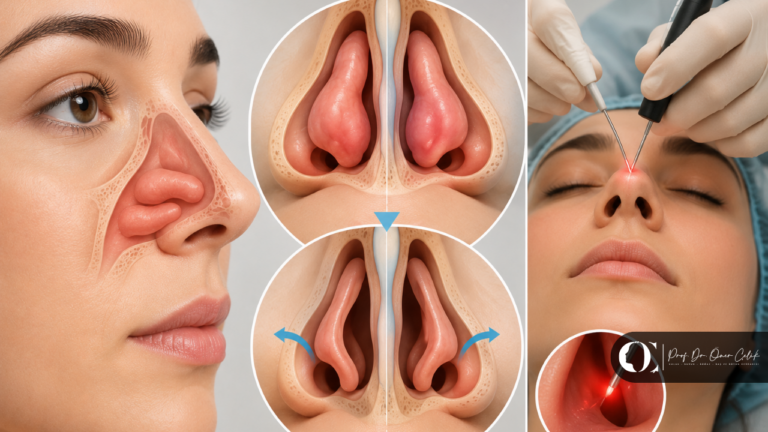


Endoscopic sinus surgery is a treatment step considered for people with chronic sinusitis who have not responded adequately to appropriate medical treatment. Its aim is not to eliminate the disease but to ventilate the sinuses and allow medical treatment to work. Treatment needs to continue after the operation as well.
Most people living with chronic sinusitis ask the same question: “I’ve had enough. If I have surgery, will it be over?”
The honest answer differs from most of the answers you will find online.
Endoscopic sinus surgery is an effective method and makes a clear difference in the right patient. However, it is not a procedure that ends the disease. This is not a shortcoming of the technique but a fact related to the nature of the disease.
In this article I explain what the operation actually does, when it is considered, where the balloon method fits in and what needs to continue after surgery.
What is chronic sinusitis?
Chronic rhinosinusitis is defined as inflammation of the lining of the nose and sinuses lasting longer than 12 weeks. Symptoms include nasal blockage, nasal discharge or postnasal drip, facial pressure and fullness, and a reduced sense of smell.
The key point to understand is this: chronic sinusitis is not a recurring infection but an ongoing inflammatory disease.
This distinction directly determines treatment. An infection is treated and ends; an inflammatory disease is brought under control and monitored, just like asthma or eczema.
The disease is classified into two main forms: chronic rhinosinusitis with nasal polyps and without nasal polyps. This distinction changes both the treatment plan and the long-term outlook.
Medical treatment first: why it cannot be skipped
The guidelines are clear on this, and the level of evidence is high.
The European Position Paper on Rhinosinusitis and Nasal Polyps states that in most patients with chronic rhinosinusitis appropriate medical treatment is as effective as surgery, and that surgery should therefore be reserved for patients who do not respond adequately to treatment. This is supported by one of the highest levels of evidence.
Appropriate medical treatment usually includes:
- Saline nasal irrigation – simple, but the cornerstone of treatment
- Intranasal corticosteroids – as a spray or in a rinse solution
- A short course of systemic corticosteroids where considered necessary
- An appropriate antibiotic if there are signs of bacterial infection
- Treatment of coexisting allergy
This treatment must be used for long enough and in the right way. The situation I see most often in practice is this: a patient says “I used the medication and it didn’t help”; on closer questioning it turns out the spray was used for a few weeks and then stopped, or applied with the wrong technique.
Treatment that has not been used correctly does not count as failed treatment. The decision to operate should only be made after treatment has genuinely been tried adequately.
What does the operation actually do?
This section is the most important part of the article, because the purpose of the operation is often misunderstood.
The goals of endoscopic sinus surgery are clearly defined in the guidelines:
- To create an opening that incorporates the natural opening of the sinus
- To provide adequate ventilation of the sinus
- To facilitate mucociliary clearance
- To allow topical medication to reach the inside of the sinus
I want to dwell on the fourth point in particular, because it sums up the whole logic.
Before surgery, a medication sprayed into the nose cannot reach the sinus because the passages are narrow and blocked. The operation opens these passages. The result: surgery does not replace medication – it makes it possible for medication to work.
This is even more pronounced in patients with polyps. The guidelines define the aim of surgery as removing diseased mucosa and polyps, allowing corticosteroids to reach the sinuses and thereby improving the results of medical treatment after surgery.
In other words, the operation is not the end of treatment; it is a precondition for effective treatment.
When is surgery considered?
Situations that call for a surgical assessment include:
- Persistent symptoms despite appropriate medical treatment of sufficient duration
- Objective evidence of disease on endoscopy or CT
- Extensive polyposis obstructing nasal breathing
- Coexisting asthma that cannot be brought under control
- One-sided sinus blockage – this requires separate assessment
- Structural lesions such as a fungal ball
- Complications extending to the area around the eye or the skull base
The last two points differ from the others and require priority assessment.
A note on imaging: CT is usually performed after medical treatment has been completed. A scan taken during an active infection can overstate the real extent of the disease.
Where does balloon sinuplasty fit in?
The balloon method has been much discussed in recent years and is often presented as an alternative to endoscopic surgery. The reality is more nuanced.
In balloon sinuplasty, a thin catheter is placed in the sinus opening and the balloon at its tip is inflated to widen the narrowing. No tissue is removed. In some cases the procedure can be done under local anaesthesia in an outpatient setting.
Where is it suitable?
The balloon method is considered indicated in limited chronic rhinosinusitis without polyps – in cases affecting the maxillary, frontal and sphenoid sinuses.
Where does it fall short?
This is the critical point: a balloon cannot treat ethmoid sinus disease.
The ethmoid sinuses lie between the eyes and consist of many small cells. A balloon catheter cannot be used on this structure – there is no single opening to widen.
And nasal polyps develop mainly precisely in the ethmoid region.
The practical consequence: in a patient with chronic rhinosinusitis with polyps, the balloon method cannot reach the area where the disease is. This is not a flaw of the method but a limit of its field of use.
Can they be combined?
Yes. Balloon dilation and endoscopic surgery can be performed in the same session; this is called a hybrid procedure. For example, while the ethmoid region is opened endoscopically, the frontal sinus opening can be widened with a balloon.
So the right question is not “balloon or surgery?”. The right question is: which sinuses are affected, and are there polyps? The answer determines the method by itself.
Managing expectations: the most important section
The 2025 clinical practice guideline on surgical management from the American Academy of Otolaryngology–Head and Neck Surgery contains a key action statement for doctors. It requires that patients be told the following before surgery:
- That the disease is chronic and may recur
- That long-term medical treatment is needed
- That these may vary according to the subtype of the disease
The same guideline states that surgery should only be recommended when the expected benefit outweighs non-surgical management, outcomes have been clarified, and the patient understands the expectation of long-term disease management after surgery.
My reason for quoting these points is simple: if a guideline tells doctors “do not promise a cure; explain the chance of recurrence”, then patients also need to make their decision knowing this.
Success rates and recurrence
Long-term success rates reported in the literature range from 76% to 98%. This wide range varies with the subtype of the disease and the study method.
However, the same sources also note that a significant proportion of patients have persistent symptoms or a recurrence within the first one to two years.
A concrete figure: in a national study of 3,506 patients operated on for chronic rhinosinusitis with nasal polyps, 15.9% had at least one revision operation. The median time to revision was reported as 425 days.
These figures are not meant to discourage but to set a realistic frame. A second operation being needed in about one in six patients also means it was not needed in five out of six.
Why might surgery fall short?
The main reasons described in the literature are lateralisation of the middle turbinate, formation of adhesions, renarrowing of the opened passage, persistent or recurrent mucosal swelling, and regrowth of polyps.
Some of these depend on surgical technique, some on postoperative care, and some on the severity of the underlying inflammatory process.
After surgery: the decisive period
The operation is not the end of treatment but the start of a new phase. How this phase is managed clearly affects the long-term outcome.
- Regular saline nasal irrigation. This is the most important measure after surgery and is usually continued for a long time.
- Continuing topical corticosteroid treatment. This is the real benefit of the operation – the medication can now reach the sinuses. Stopping it means losing the advantage gained.
- Endoscopic follow-up. Adhesions and narrowing are easy to manage if they are noticed early.
- Treatment of coexisting conditions. Sinus disease cannot be controlled unless allergy and asthma are controlled.
- Stopping smoking. Smoking directly impairs mucociliary clearance.
The second point could be called the summary of the whole article. A patient who stops medication after surgery does not use the opportunity the operation has created.
An additional option for patients with polyps
In recent years, biologic agents have become one of the treatment options for chronic rhinosinusitis with nasal polyps driven by type 2 inflammation. They may be considered in patients whose disease persists despite conventional treatment.
This is not an option that replaces surgery but a development that widens the range of treatment. Eligibility requires a separate assessment.
Risks of the operation
Endoscopic sinus surgery is considered a safe procedure. In children, reported complication rates are about 0.6% major and 2% minor.
Possible issues include bleeding, adhesions, changes in the sense of smell and – rarely – complications related to the neighbouring eye socket or skull base.
The anatomical closeness of the sinuses to the eye and the skull base explains why this surgery requires detailed anatomical knowledge. Careful review of the preoperative CT scan is therefore part of standard practice.
Questions to discuss before deciding
- Was my medical treatment used for long enough and with the correct technique?
- Do I have polyps, and which sinuses are affected?
- Is the balloon method suitable in my case, and why?
- Which treatment will I continue after surgery, and for how long?
- How likely is recurrence for my subtype?
- How will my coexisting allergy or asthma be managed?
- What should I expect regarding my sense of smell?
Points four and five correspond exactly to the information the guidelines require from the doctor. If you cannot get clear answers to these questions, seeking a second opinion is a reasonable step.
In summary
Endoscopic sinus surgery is an effective treatment step for people with chronic rhinosinusitis who have not responded adequately to appropriate medical treatment. The guidelines state that in most patients medical treatment is as effective as surgery; surgery is therefore not the first step.
The aim of the operation is not to eliminate the disease. It is to ventilate the sinuses, facilitate mucociliary clearance and allow topical medication to reach the sinuses. In other words, surgery does not replace medication; it allows medication to work.
The balloon method can be a suitable option in limited cases without polyps; however, because it cannot reach the ethmoid region, it is not sufficient on its own for patients with polyps. The two methods can also be combined in the same session.
Current guidelines require that, before surgery, patients are told that the disease may be chronic, may recur and may need long-term medical treatment. This information does not diminish the value of surgery; it ensures that patients start with the right expectations.
If you have ongoing sinusitis symptoms, it is advisable to see an ear, nose and throat doctor so that the subtype of the disease can be determined and the appropriate treatment step chosen.
You can send your questions via WhatsApp; I add frequently asked topics to this article.
This content is for information only and does not replace a medical consultation, diagnosis or treatment. Results vary from person to person. For your individual situation, please consult a doctor in the relevant specialty.
Frequently Asked Questions
Does sinus surgery cure the disease completely?
No. Chronic rhinosinusitis is an ongoing inflammatory disease, and surgery does not eliminate it. Its aim is to ventilate the sinuses and allow medical treatment to work. Current guidelines require that patients are told before surgery about the chance of recurrence and the need for long-term medical treatment.
When is surgery needed?
It is considered if symptoms persist despite appropriate medical treatment of sufficient duration and the disease has been shown objectively on endoscopy or CT. The guidelines state that in most patients medical treatment is as effective as surgery.
Is balloon sinuplasty an alternative to endoscopic surgery?
Not in every case. The balloon method is suitable in limited cases without polyps – those affecting the maxillary, frontal and sphenoid sinuses. It cannot reach ethmoid sinus disease, and because polyps develop mainly in this region, it is not sufficient on its own for patients with polyps.
Can the two methods be combined?
Yes. Performing balloon dilation and endoscopic surgery in the same session is called a hybrid procedure. For example, while the ethmoid region is opened endoscopically, the frontal sinus opening can be widened with a balloon.
Will I need to keep using medication after surgery?
Usually yes. The real benefit of the operation is that topical medication can now reach the sinuses. Stopping treatment means losing the advantage the operation has provided. The duration and content are set by the doctor according to the subtype of the disease.
Will I need another operation?
Some patients may. In a national study of 3,506 patients operated on for chronic rhinosinusitis with nasal polyps, 15.9% had at least one revision operation, and the median time to revision was reported as 425 days.
What is the success rate?
Long-term success rates reported in the literature range from 76% to 98%. This wide range varies with the subtype of the disease and the study method. The same sources also note that some patients have persistent or recurrent symptoms.
Will my sense of smell come back?
Loss of smell is a common finding in chronic rhinosinusitis and is particularly marked in patients with polyps. Improvement may be seen with surgery and the treatment that follows, but the outcome varies with the individual and the duration of the disease. Expectations on this point should be discussed before surgery.
Prof. Dr. Öner Çelik – Ear, Nose and Throat, Head and Neck Surgery. He graduated from Istanbul University Faculty of Medicine and completed his ENT specialist training at Taksim Training and Research Hospital. He served as a faculty member in the Department of Otorhinolaryngology and Head and Neck Surgery at Maltepe University Faculty of Medicine and in 2013 received training in advanced endoscopic sinus surgery and skull base surgery at the Ohio State University Wexner Medical Center. He is a member of the Turkish Society and Foundation of Otorhinolaryngology and Head and Neck Surgery. About Prof. Dr. Öner Çelik
References
- Fokkens WJ, et al. European Position Paper on Rhinosinusitis and Nasal Polyps 2020 (EPOS 2020). Rhinology.
- Shin JH, et al. Clinical Practice Guideline: Surgical Management of Chronic Rhinosinusitis. Otolaryngology–Head and Neck Surgery, 2025.
- Hellings PW, et al. EUFOREA/EPOS2020 statement on the clinical considerations for chronic rhinosinusitis with nasal polyps care. Allergy 2024.
- Predictors of revision endoscopic sinus surgery in Finnish patients with chronic rhinosinusitis with nasal polyps (3,506 patients).
- American Academy of Otolaryngology–Head and Neck Surgery. Clinical Indicators: Endoscopic Sinus Surgery, Adult.
- Sinha, et al. Balloon sinus dilation versus functional endoscopic sinus surgery: systematic review and meta-analysis, 2023.
This content is for information only and does not replace medical advice. Every medical procedure requires an individual assessment and may carry risks. Results vary from person to person.